
 Sanket GhoshDecember 24, 2025
You ran the ad. You spent the budget. And then, nothing. No spike in inquiries. No uptick in sales. Just silence, and a receipt you can’t take back.
Sound familiar? You’re not alone. Thousands of business owners in India pour money into advertising every year without a clear answer to the most basic question: where should this actually go?
TV feels prestigious. Social feels modern. Both promises are reached. But they deliver very differently, and betting on the wrong one at the wrong time doesn’t just waste money, it costs you momentum you can’t easily recover.
This blog cuts through the noise. By the end, you’ll know exactly which medium fits your goal, your audience, and your budget, and how to use both so that every rupee works harder than it did before.
Table of Contents
ToggleA] What Is TV Advertising?
TV advertising is paid brand communication broadcast through television, commercials, sponsored segments, and infomercials. In India, it still reaches over 900 million viewers across 900+ channels. That’s a number worth respecting.
Think about campaigns like Vodafone’s ZooZoos or Fevicol’s iconic ads, both classics from an era when television was the undisputed centre of household attention. They became cultural moments. That’s what TV can do when the stars align: big budget, broad reach, the right slot. For mass-reach and top-of-funnel recognition, particularly in FMCG, real estate, and consumer durables, TV advertising advantages still exist. They’re just harder to access without significant investment, which is why many brands also look for an experienced ad film production house in Mumbai to create impactful campaigns that connect with wider audiences.
B] What Is Social Media Advertising?
Social media advertising is a paid digital marketing strategy that runs across Instagram, YouTube, Facebook, LinkedIn, and ShareChat through Reels, Stories, in-feed videos, carousels, and influencer partnerships. And right now, it’s where the most interesting brand building is happening.
What changed the game was targeting. A mid-sized skincare brand in Pune can reach women aged 25–38 in Tier 1 cities who’ve recently searched for moisturisers, and pay only when someone clicks. That’s the core shift in TV vs online advertising.
Short-form video has taken this even further. Reels and YouTube Shorts are where attention actually lives right now. Brands with sharp creative on these platforms consistently outperform their traditional media spend, at a fraction of the cost.
C] Difference Between Commercial and Social Marketing
The difference between commercial and social marketing isn’t just about platforms; it’s about how people receive your message.
| Feature | TV Advertising | Social Media Advertising |
|---|---|---|
| Reach | Mass, broad | Precise, behaviour-based |
| Cost | Higher production + placement | Flexible, scales with budget |
| Engagement | Passive viewing | Interactive, shares, comments, DMs |
| Targeting | Age/gender demographics | Interests, location, lookalikes |
| Analytics | TRP ratings | Real-time clicks, views, conversions |
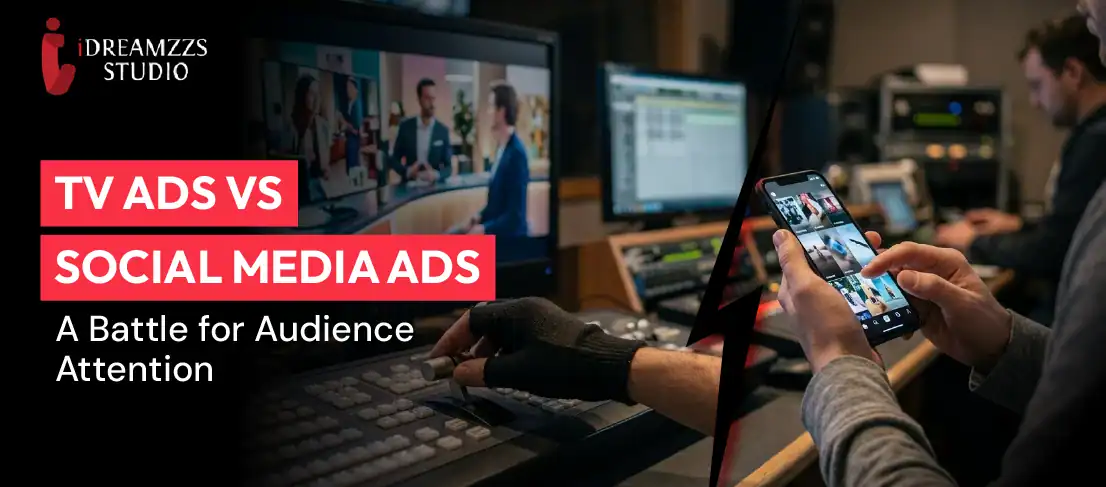
TV puts your brand in front of millions. Social puts it in front of the right ones and tells you exactly what happened after. That’s the clearest way to understand where TV advertising vs internet advertising diverges, and why more brands are shifting their active budgets toward digital while keeping TV for selective, high-stakes moments.
Reach your audience where it matters most with the right advertising strategy.
Let iDREAMZZS Studio help you choose between TV ads and social media ads for better results.
D] Benefits of TV Advertising and Social Media Advertising
I] TV Advertising
The TV advertising advantages are real when used correctly. Here’s where TV genuinely earns its place:
- Mass reach, instantly. A prime-time spot puts your brand in front of millions simultaneously; no digital platform matches that scale in a single window.
- Credibility by association. National TV signals that your brand is established. For trust-driven industries like finance, healthcare, and insurance, that perception shift is powerful.
- Emotional storytelling. A well-crafted TVC moves people, not just informs them. That emotional imprint drives long-term recall.
- OTT reach. Platforms like Hotstar and JioCinema extend your TVC beyond cable to streaming audiences too.
II] Social Media Advertising
If TV is a highway billboard, social is a one-on-one conversation at exactly the right moment. In the TV vs social media advertising comparison, this is where social media pulls ahead:
- Precision targeting. Age, location, interests, recent behaviour, you reach exactly who matters, no wasted impressions.
- Full accountability. Every click, conversion, and drop-off is tracked in real time. No waiting for TRP reports.
- Flexible budgets. ₹500 or ₹50 lakh, social scales with you at every stage.
- Native formats. Reels, Stories, Shorts, content that fits how people already consume, not interrupts it.
E] When TV Advertising Works Better
TV earns its place in specific, high-stakes scenarios, big national launches, IPL season, Diwali campaigns, or categories where mass-market presence is non-negotiable. Regional storytelling is another genuine strength; connecting emotionally with audiences through local language and cultural nuance is something TV handles well. Just go in knowing the investment is substantial and results, while real, are harder to measure with precision.
F] When Social Media Advertising Works Better
Social media advertising works better for most businesses in 2025. If your goal is a specific action, a sign-up, purchase, booking, or download, social wins. It works well on targeting, speed, cost-efficiency, and measurability. All four, at once.
It’s also the undisputed home for personal brands and creators. Building an audience, growing a community, positioning yourself as an expert, social media is your stage, distribution channel, and feedback loop simultaneously. No other platform gives you that combination.
Even for established businesses, the ability to test, learn, and scale quickly makes social the natural starting point for most campaign strategies today.
G] Combining Both: A Smart Hybrid Advertising Strategy
Here’s something most agencies won’t tell you upfront: the TV vs. social media advertising debate is largely artificial. Top brands don’t choose, they integrate.
A campaign that truly works flows. A high-production ad film is shot for TV broadcast. That same footage is cut into 15-second Reels, YouTube bumper ads, and Stories. Audiences who saw the TVC on television get retargeted on Instagram with a direct-response message. By the time someone sees your brand for the fifth time, conversion becomes natural.
This is the multi-channel approach that consistently outperforms either medium alone. And it only works when you have a production partner who understands both the art of storytelling and the science of platform optimisation.
H] How iDREAMZZS Can Help You Win Both
Producing high-impact advertising content requires more than cameras and editing software. It demands strategic storytelling, audience insight, and distribution expertise.
iDREAMZZS Studio, a creative video production house in India, we are specialises in cinematic ad films, corporate videos, and digital campaigns designed to connect with audiences across multiple platforms.
By combining creative direction with marketing strategy, the studio helps brands create compelling video content tailored to their unique objectives.
Whether businesses require broadcast-quality television commercials or engaging digital campaigns, the team ensures that every project stands out in the evolving world of bold TV vs social media advertising.
Want stronger brand visibility and higher engagement for your business?
Connect with iDREAMZZS Studio to create impactful ad campaigns that deliver real attention.
Conclusion
To achieve the best results, brands usually combine both. Television creates visibility at scale, while social media keeps the conversation going and drives action. When combined, they turn awareness into measurable growth. What really makes the difference is storytelling behind the campaign. That’s why many brands choose to collaborate with an experienced ad film agency in Mumbai that understands how to shape one idea into content that performs across both television and digital platforms.
FAQs
For most small businesses, social media marketing ads work better because they offer lower costs, better audience targeting, and real-time tracking. Platforms like Instagram ads, Meta ads, and Google Ads help businesses reach the right audience without spending heavily like traditional TV advertisement campaigns. However, TV can still work well for large-scale local visibility and brand trust.
The biggest TV ads vs social media ads pros and cons come down to reach and targeting. TV ads for products provide massive visibility and strong brand recall, especially with Indian TV ads and some of the best ads on TV. On the other hand, ads on social media offer precise targeting, better engagement, and measurable ROI through tools like Ads Manager, LinkedIn Ads, and social media ads design strategies.

Sanket Ghosh
Sanket Ghosh is the Founder & Creative Director at iDREAMZZS Studio, Mumbai, specializing in strategic video marketing for manufacturers and product-based brands. With a strong focus on performance-driven storytelling, he helps businesses boost visibility, engagement, and sales through impactful video content, including product explainers, ad campaigns, and conversion-focused video funnels. Sanket is passionate about creating videos that not only engage but also build trust and drive measurable growth.